
Meteora: the complete guide, and how to see it properly in one day
Written by the drivers who take guests from Thessaloniki and Halkidiki to Kalambaka every week — monasteries, timings, dress code, viewpoints and the honest details nobody puts in a brochure.
By the Vanntransfers travel team · Last reviewed July 2026 · Reading time ~35 minutes
- Licensed & insuredGreek-licensed private hire, fully insured passengers
- Mercedes-Benz onlyE-Class, V-Class and minibus, non-smoking
- Answered in minutesDirect WhatsApp with your driver, before and during
Why Meteora deserves an entire day
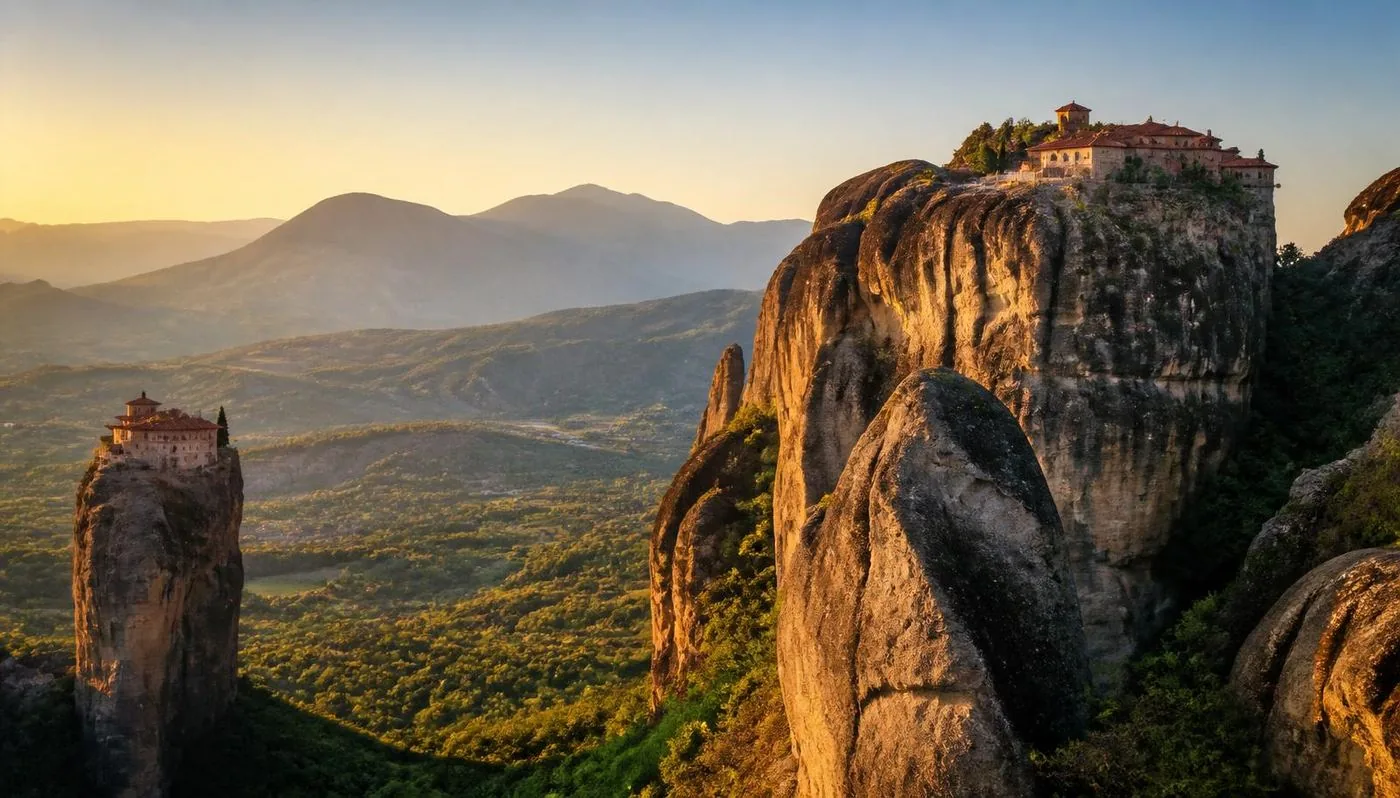
There are places that photograph well and places that change the temperature of the air around you. Meteora is the second kind. Six hundred metres of grey sandstone rise straight out of the flat Thessalian plain, and on top of them sit monasteries that monks built by hauling every beam, stone and barrel up by rope. You see it first from the road below Kastraki, and almost everyone goes quiet.
The scale is impossible to grasp from photographs. The pillars were formed over roughly sixty million years, as a river delta of conglomerate rock was lifted, split by tectonic movement and then carved by water and wind into isolated towers. Hermits moved into the caves in the eleventh century. The first organised monastery followed in the fourteenth, when Serbian and Byzantine patronage made building at that height financially possible.
Most visitors give Meteora three hours between two coach stops. That is enough to see it and not nearly enough to feel it. A full day lets you arrive before the tour buses, spend real time inside two or three monasteries, eat properly in Kalambaka rather than at a roadside stop, and stay for the light at the end of the afternoon, when the rock changes from grey to gold to deep bronze in about twenty minutes.
That is the case for a private day trip rather than a seat on a coach: not luxury for its own sake, but control over the one variable that matters here — time.
Prefer to arrive before the coaches, at 10:00, with the whole car to yourselves?
Book my private tourA short, honest history of Meteora
The name means 'suspended in the air'. It was given by St. Athanasios the Meteorite, who climbed the largest pillar in the 1340s and founded the monastery now called Great Meteoron. He was not the first religious presence here: ascetic hermits had been living in the caves and rock fissures since around the eleventh century, coming down only for Sunday liturgy at a small chapel in the valley.
The fourteenth century was a violent period in the Balkans, and the rocks offered something no walled town could — genuine inaccessibility. Over the following two hundred years the community grew to twenty-four monasteries. Monks and supplies went up in nets hoisted by hand-cranked winches; the ropes, according to a much-repeated local story, were replaced 'only when the Lord let them break'. Steps carved into the rock came much later, in the 1920s, and are the reason ordinary visitors can reach the monasteries today.
Decline set in after the seventeenth century, accelerated by taxation, isolation and later by the destruction of the Second World War, when several monasteries were bombed and looted. Six remain active: four with monks, two with nuns. In 1988 UNESCO inscribed Meteora on the World Heritage list under both cultural and natural criteria — a rare double listing given to places where human achievement and landscape cannot be separated.
It matters to remember, walking through them, that these are not museums. Services are held daily, and the people you pass in the courtyards live there.
What monastic life here actually looks like
The rhythm has barely changed. Services begin before dawn; work in the gardens, the icon workshops and the guest areas fills the day; the monasteries close to visitors in the early afternoon precisely so that community life can resume. This is the practical reason opening days rotate: each monastery takes a fixed day off each week, and the days are staggered so that visitors always have options.
You will notice small things if you look. Ossuaries where the skulls of previous generations are kept and named. Kitchens blackened by five centuries of woodsmoke. Wine barrels the size of a car. Icon painters still using egg tempera and gold leaf. Photography is generally not permitted inside the churches, and this is enforced kindly but firmly — respect it, and you will be welcomed anywhere else.
The six monasteries, compared honestly
All six are worth seeing and no one sees all six well in a single day. Use this table to pick two or three that match your legs, your interests and the day of the week you are travelling. Closing days rotate seasonally — always confirm shortly before you go.
Great Meteoron (Holy Monastery of the Transfiguration)
- Founded
- 1340s, by St. Athanasios the Meteorite
- Difficulty
- Hardest
- Usual closing day
- Usually closed Tuesdays (and Wednesdays in winter)
The largest and oldest monastery, and the only one with a proper museum. The old kitchen, the barrel-vaulted refectory and the ossuary give you the clearest picture of how monks actually lived here for six centuries.
Wide-angle shots of Varlaam from the connecting path — the classic Meteora postcard frame.
≈300 steps
Varlaam Monastery
- Founded
- 1541, on a hermitage of 1350
- Difficulty
- Moderate–hard
- Usual closing day
- Usually closed Fridays (and Thursdays in winter)
Second largest, with the finest surviving frescoes of the complex, painted in 1548 by Frangos Katelanos. The original rope-and-net winch tower and the huge oak wine barrel are still in place.
The winch tower balcony, and the courtyard framing the Great Meteoron rock.
≈195 steps
Roussanou (St. Barbara)
- Founded
- 16th century, restored as a nunnery in 1988
- Difficulty
- Easy–moderate
- Usual closing day
- Usually closed Wednesdays
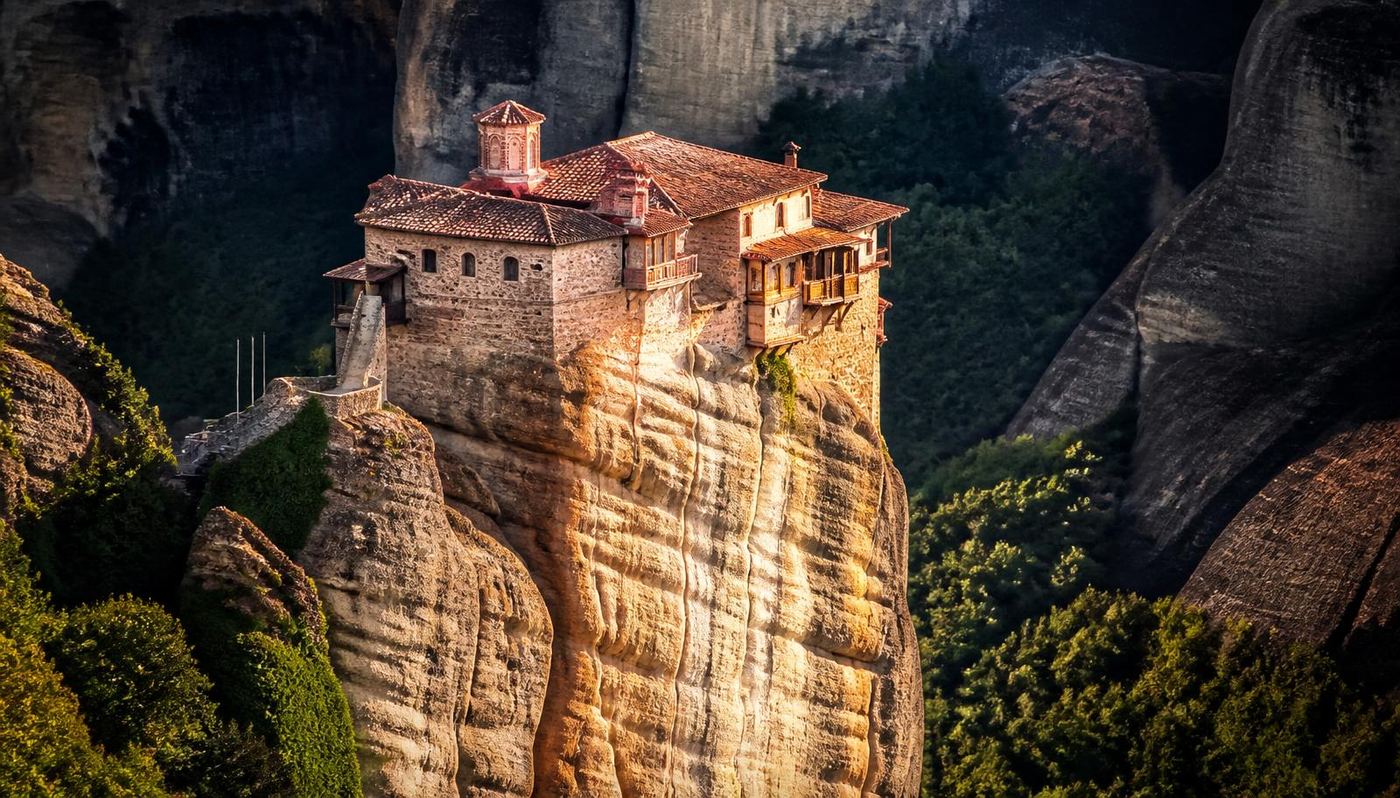
The building covers the entire rock, so it looks as though it grew out of the stone. Small, intimate and full of flowers — the favourite of most first-time visitors.
From the road above at golden hour: the whole monastery glows orange against the valley.
≈140 steps, plus two footbridges
St. Nicholas Anapafsas
- Founded
- early 16th century
- Difficulty
- Moderate
- Usual closing day
- Usually closed Fridays
Built vertically on a narrow pillar over several floors because there was no room to build outwards. The 1527 frescoes by the Cretan master Theophanes Strelitzas are among the most important in Greece.
First monastery on the way up from Kastraki — beautiful in morning light.
≈150 steps, steep
Holy Trinity (Agia Triada)
- Founded
- 1475–1476
- Difficulty
- Hard (the approach, not the height)
- Usual closing day
- Usually closed Thursdays
The one from the James Bond film For Your Eyes Only. The most dramatically isolated of all six, with a view over Kalambaka that stops conversations.
From the Psaropetra area, especially at sunset when the rock turns bronze.
≈140 steps carved into the rock, after a descent and climb
St. Stephen
- Founded
- 14th century, nunnery since 1961
- Difficulty
- Easiest / step-free
- Usual closing day
- Usually closed Mondays
The only monastery reachable without climbing, which makes it the right choice for grandparents, wheelchair users and anyone travelling with a pushchair. The terrace overlooks the whole Thessaly plain.
The terrace panorama over Kalambaka and, on clear days, Mount Olympus far to the east.
No steps — a short level bridge
Hour by hour: how our day actually runs
This is the timetable we use for a Thessaloniki pickup in spring or autumn. Nothing in it is fixed — it is your vehicle, and the sequence changes the moment you say so.
- 06:45
Door-to-door pickup
Your driver arrives at your hotel, villa or the airport with water, phone chargers and a cool cabin. From Halkidiki resorts we start around 06:00.
- 07:00–08:30
Egnatia motorway west
Comfortable motorway driving past Mount Olympus. Most guests sleep — the seats recline and the cabin is quiet.
- 08:30
Coffee stop
A short break at a service station or a village café. No fixed schedule: it is your car, so you stop when you want to.
- 10:00
Arrival in Kastraki
The first view of the pillars from below. We pause for photos before driving up — this is the shot people remember.
- 10:20–12:00
First two monasteries
Usually Great Meteoron and Varlaam, or St. Nicholas if you prefer fewer steps. You go in at your own pace; your driver waits at the gate.
- 12:15
Panoramic drive
The circular monastery road with three or four photo stops, including the Roussanou bend and the Holy Trinity overlook.
- 13:00–14:30
Lunch in Kalambaka or Kastraki
A relaxed traditional meal — we book a table with a rock view in advance if you like.
- 14:45–16:00
Third monastery or free time
St. Stephen (step-free) or Holy Trinity, or the icon workshops and the Byzantine Church of the Dormition in the old town.
- 16:15
Sunset option
In spring and autumn we can wait for golden hour at Psaropetra before heading back. Simply tell your driver on the day.
- 16:30–19:30
Return
Back to your hotel, with a dinner stop on request. No hurry, no group waiting on you.
We can build this timetable around your flight, your ship or your children's nap.
Book my private tourThe best viewpoints and photography spots
Half of Meteora's magic is seen from the road rather than from inside the monasteries. These are the stops we make, in the order that the light suits them.
Psaropetra (Sunset Rock)
The most famous sunset platform in Meteora, looking straight at Holy Trinity and Roussanou. Arrive 45 minutes before sunset in summer — it fills up.
Great Meteoron viewpoint
Elevated view over Varlaam with the plain behind it. Best light before 11:00, and far quieter than the afternoon.
Roussanou upper bend
A roadside curve where the whole monastery sits below you. Thirty seconds from the car — perfect if walking is difficult.
Kastraki panorama
The village and its rock towers wrapped in valley mist. Only realistic if you stay overnight in Kalambaka.
Holy Spirit rock trail viewpoint
A short hike rewarded with the least photographed angle of the whole complex — good if you want images nobody else has.
Kalambaka town square, looking up
The floodlit monasteries above the rooftops. A lovely last shot before the drive home.
Photography: where to stand and when
Meteora is a landscape of backlight problems. In the middle of the day the rock flattens out and the sky blows out behind it. Early morning and the last ninety minutes before sunset are when the pillars gain texture and the monasteries separate from the cliffs behind them.
Bring a wide lens for the rock formations and something around 70–200mm for compressing the monasteries against the plain — the compressed shots are what look extraordinary. A polariser helps enormously with the haze that sits over Thessaly in summer. Drones are restricted around the monasteries; do not fly without checking the current rules, as fines are real and enforcement has increased.
Inside the churches, photography is not permitted. In courtyards and on terraces it usually is. When in doubt, ask — a nod from a monk is worth more than a deleted memory card.
Private tour or coach tour — an honest comparison
A coach day trip from Thessaloniki is genuinely cheaper if you are two people. It is not cheaper for a family of four or five, and it costs you the things that make Meteora memorable: departure time, pace, lunch choice and the option to stay for sunset.
The other real difference is the drive. It is around 240 kilometres each way. In a Mercedes E-Class or V-Class with one professional driver and no other passengers, six hours of driving becomes rest time. On a full coach with fixed rest stops, it does not.
- Private Mercedes day trip
- Chosen by you, typically 06:45 to beat the coaches
- Coach group tour
- Fixed, usually 07:30–08:30 with multiple hotel pickups
- Private Mercedes day trip
- Door to door — hotel, villa, airport or ship
- Coach group tour
- Central meeting point, sometimes a walk with luggage
- Private Mercedes day trip
- Mercedes E-Class or V-Class, your party only
- Coach group tour
- Coach shared with 30–50 passengers
- Private Mercedes day trip
- Flexible, you decide when to leave
- Coach group tour
- Fixed slots, group must reassemble
- Private Mercedes day trip
- Restaurant of your choice, table booked ahead
- Coach group tour
- Group restaurant with a set menu
- Private Mercedes day trip
- Possible on request
- Coach group tour
- Almost never
- Private Mercedes day trip
- Optional add-on in Kalambaka
- Coach group tour
- Usually included
- Private Mercedes day trip
- From 600€ per vehicle (up to 7 people)
- Coach group tour
- Roughly 80–120€ per person
- Private Mercedes day trip
- Families, couples, cruise guests, anyone valuing time
- Coach group tour
- Solo travellers and couples on a tight budget
| Private Mercedes day trip | Coach group tour | |
|---|---|---|
| Departure time | Chosen by you, typically 06:45 to beat the coaches | Fixed, usually 07:30–08:30 with multiple hotel pickups |
| Pickup | Door to door — hotel, villa, airport or ship | Central meeting point, sometimes a walk with luggage |
| Vehicle | Mercedes E-Class or V-Class, your party only | Coach shared with 30–50 passengers |
| Time at the monasteries | Flexible, you decide when to leave | Fixed slots, group must reassemble |
| Lunch | Restaurant of your choice, table booked ahead | Group restaurant with a set menu |
| Sunset | Possible on request | Almost never |
| Licensed guide | Optional add-on in Kalambaka | Usually included |
| Typical cost | From 600€ per vehicle (up to 7 people) | Roughly 80–120€ per person |
| Best for | Families, couples, cruise guests, anyone valuing time | Solo travellers and couples on a tight budget |
Driving to Meteora yourself
It is perfectly possible. The route is Thessaloniki → A2 Egnatia Odos westbound → A1/PATHE south → E65 towards Trikala/Kalambaka, roughly three hours with tolls in each direction. The motorways are modern and well signed in Latin script.
What people underestimate is the monastery road itself: narrow, winding, with blind bends, tour coaches taking the whole width and cyclists on the climbs. Parking is limited and, from June to September, genuinely difficult between 11:00 and 15:00 — the small lots at Great Meteoron and Varlaam fill first, and the roadside spaces that remain often mean a long uphill walk in full sun.
There is also the fatigue question. Six hours of driving plus several hundred steps in one day is a lot, and the return leg happens exactly when you are most tired. If you do drive, leave Thessaloniki no later than 07:00, fill up before Larissa, and carry cash for parking and entrance fees.
- Driving yourself
- Cheaper (rental, fuel, tolls, parking)
- Private driver
- Higher, but fixed and all-inclusive
- Driving yourself
- Similar or higher once you need a large car
- Private driver
- Usually lower per person
- Driving yourself
- 6 hours behind the wheel, worst on the return
- Private driver
- None — the drive becomes rest time
- Driving yourself
- Narrow bends shared with coaches; stressful in peak season
- Private driver
- Handled by a driver who does it weekly
- Driving yourself
- Difficult 11:00–15:00 in summer
- Private driver
- Drop-off at the gate, driver handles parking
- Driving yourself
- Total
- Private driver
- Total
- Driving yourself
- Guidebook and luck
- Private driver
- Current opening days, best viewpoints, booked table
| Driving yourself | Private driver | |
|---|---|---|
| Cost for 2 people | Cheaper (rental, fuel, tolls, parking) | Higher, but fixed and all-inclusive |
| Cost for 5–7 people | Similar or higher once you need a large car | Usually lower per person |
| Driving fatigue | 6 hours behind the wheel, worst on the return | None — the drive becomes rest time |
| The monastery road | Narrow bends shared with coaches; stressful in peak season | Handled by a driver who does it weekly |
| Parking | Difficult 11:00–15:00 in summer | Drop-off at the gate, driver handles parking |
| Flexibility | Total | Total |
| Local knowledge | Guidebook and luck | Current opening days, best viewpoints, booked table |
Opening hours, entrance fees and closing days
Each monastery charges a small entrance fee per adult — at the time of writing 5€ — payable in cash at the gate. Children are generally admitted free. Opening hours are broadly 09:00 to 16:00 or 17:00 in summer, and 09:00 to 14:00 or 15:00 in winter, with each monastery closed one or two fixed days per week.
These schedules change with the season, with religious feast days and occasionally at short notice for restoration or liturgical reasons. Do not build a rigid plan around a single monastery. We check the current week's schedule the day before every trip and confirm the visiting order with you by message — and we still recommend that independent visitors verify the latest hours through the official Meteora monastery information channels before travelling.
The dress code, explained properly
It is a religious site, and the rule is applied at the gate of every monastery. Men need long trousers — shorts are refused, including at knee length. Women need a skirt covering the knee; trousers are not accepted at most of the monasteries, though this is applied more loosely at some than others. Shoulders must be covered for everyone.
Most monasteries keep a rack of wrap-around skirts and shawls at the entrance which you can borrow free of charge. They work, but they are shared, well-used and hot in August. If you would rather not, pack a light long skirt or a large scarf that can be tied as one, and a linen shirt.
Footwear is not a rule but it is the thing people get wrong most often. The steps are stone, uneven and polished smooth by six hundred years of use. Trainers or walking sandals with grip; not new leather soles, not flip-flops.
The best time of year — and the best hour of the day
May, early June, September and October are the ideal months: warm, clear and without the crushing heat that makes climbing three hundred steps unpleasant. April brings green valleys and wildflowers. July and August are hot — often 35°C or more in the plain — but the trip still works if you start early and treat the middle of the day as lunch and shade time.
Winter is underrated. From November to March the monasteries are almost empty, the light is soft, and a dusting of snow on the pillars is one of the great sights in Greece. Days are short and some monasteries close earlier, so a winter itinerary usually covers two monasteries rather than three.
The hour matters more than the month. Coach groups from Athens and Thessaloniki arrive between 11:00 and 15:00. Arrive at 10:00 and you will walk through Great Meteoron in near silence; arrive at 12:30 and you will queue on the steps. This is the single strongest practical argument for an early private departure.
- Summer (Jun–Sep)
- 30–38°C in the plain
- Winter (Nov–Mar)
- 3–12°C, occasional snow
- Summer (Jun–Sep)
- Heavy 11:00–15:00
- Winter (Nov–Mar)
- Very light, often near-empty
- Summer (Jun–Sep)
- Longer, typically until 16:00–17:00
- Winter (Nov–Mar)
- Shorter, typically until 14:00–15:00
- Summer (Jun–Sep)
- Three comfortably
- Winter (Nov–Mar)
- Two comfortably
- Summer (Jun–Sep)
- Harsh midday, superb golden hour
- Winter (Nov–Mar)
- Soft all day, dramatic with mist
- Summer (Jun–Sep)
- After 20:30 — very long day
- Winter (Nov–Mar)
- Around 17:15 — easy to include
- Summer (Jun–Sep)
- Hat, sunscreen, 2L of water
- Winter (Nov–Mar)
- Warm coat, grippy shoes, gloves
| Summer (Jun–Sep) | Winter (Nov–Mar) | |
|---|---|---|
| Temperature | 30–38°C in the plain | 3–12°C, occasional snow |
| Crowds | Heavy 11:00–15:00 | Very light, often near-empty |
| Monastery hours | Longer, typically until 16:00–17:00 | Shorter, typically until 14:00–15:00 |
| Monasteries per day | Three comfortably | Two comfortably |
| Light for photography | Harsh midday, superb golden hour | Soft all day, dramatic with mist |
| Sunset time | After 20:30 — very long day | Around 17:15 — easy to include |
| What to pack | Hat, sunscreen, 2L of water | Warm coat, grippy shoes, gloves |
Where to eat, and what to order
Lunch is part of the day, not an interruption to it. Kalambaka and Kastraki have a genuine local restaurant culture that has survived mass tourism better than most Greek sites, largely because the coaches eat at fixed group venues and leave the good tables free.
Traditional tavernas in Kastraki
Village setting directly under the rocks, grilled meats, garden seating. The most atmospheric lunch option.
Rooftop restaurants in Kalambaka
Several places in the upper town have terraces facing the monasteries — the view is the reason to come.
Bakeries on the main square
For a fast day: spinach pie, bougatsa and Greek coffee, eaten in twenty minutes so you gain an extra monastery.
Meat and grill houses
Thessaly is famous for its lamb and free-range pork. Ask your driver — he eats here every week and books ahead.
Thessalian dishes worth ordering
- Kalambaka-style lamb, slow-roasted until it falls off the bone
- Batzina — a rustic Thessalian courgette pie without pastry
- Trahanas soup in winter, made from fermented wheat and sheep's milk
- Local Meteora-region wine, mostly small family producers you cannot find abroad
- Fresh mountain trout from the Pineios river valley
- Halva and spoon sweets served free at the end of the meal, as is the custom here
Worth adding: what else is close
Kastraki village
Five minutes from Kalambaka, stone houses under the towers. Best short walk in the area.
Theopetra Cave
Fifteen minutes away. Human occupation traced back roughly 130,000 years and the oldest known man-made wall on earth. Check opening times before going.
Trikala old town
Half an hour away. Ottoman-era Varousi quarter, riverside cafés and the Byzantine fortress.
Pertouli and Elati
Mountain villages an hour into the Pindus range — a beautiful add-on if you are staying two days.
Mount Olympus foothills
Directly on the route home from Thessaloniki. Litochoro makes a good late-afternoon stop.
Meteora with children
It works better than parents expect, with two adjustments. First, choose the monasteries by staircase rather than by guidebook ranking: St. Stephen has no steps at all, Roussanou is short and dramatic, and Great Meteoron is the one to skip with small children unless they are strong walkers.
Second, protect the drive. Three hours each way is a lot for a six-year-old on a coach and almost nothing in a private car where you can stop at will, keep the air conditioning where you want it and put on their own music. We provide child and booster seats free of charge, and there is space in the V-Class for a pushchair.
Children respond to the story more than the architecture. Tell them about the nets and the winches on the way up and they will spend the whole visit looking for the ropes.
Accessibility and older travellers
You can experience Meteora properly with limited mobility, provided the day is planned around it. St. Stephen's Monastery is reached by a short, level bridge and has no staircase — it is the one genuinely accessible monastery, and its terrace has arguably the widest view of all six.
Beyond that, the great viewpoints are the answer. The Roussanou bend, the Great Meteoron overlook and the Psaropetra platform are all within a few dozen metres of a vehicle drop-off. A private car can stop directly at each one; a coach cannot, because it parks where coaches are permitted, not where you need to be.
Tell us in advance about walking sticks, wheelchairs, oxygen or anything that affects transfers, and the driver will plan the stop sequence and the walking distances around it rather than the other way round.
Weather and what to pack
- Summer (Jun–Aug): 30–38°C. Water, hat, sunscreen, and the visit split around a long lunch.
- Spring & autumn (Apr–May, Sep–Oct): 18–27°C, the best conditions of the year. A light layer for the terraces.
- Winter (Nov–Mar): 3–12°C, occasional snow and low cloud. Warm coat, grippy shoes; the monastery interiors are unheated.
- Always: comfortable closed shoes, long trousers or a long skirt, covered shoulders, a scarf, cash for entrance fees, and a power bank.
- Optional but useful: binoculars for the hermit caves, and a small torch for dim church interiors — not for photography, for seeing.
Cruise passengers and time-limited visitors
Ships calling at Thessaloniki normally allow eight to ten hours ashore, which is tight but workable for Meteora if — and only if — the day is run privately. The maths is fixed: roughly three hours out, three hours back, leaving two to three hours on the rocks. There is no margin for a coach that waits for stragglers.
We run these days on a strict schedule tied to your all-aboard time, with a monastery plan trimmed to two visits and one panoramic loop, and we keep in touch by WhatsApp throughout. If your ship's schedule genuinely does not allow it, we will tell you honestly and suggest an alternative rather than sell you a trip you will spend watching the clock.
The car you will be travelling in
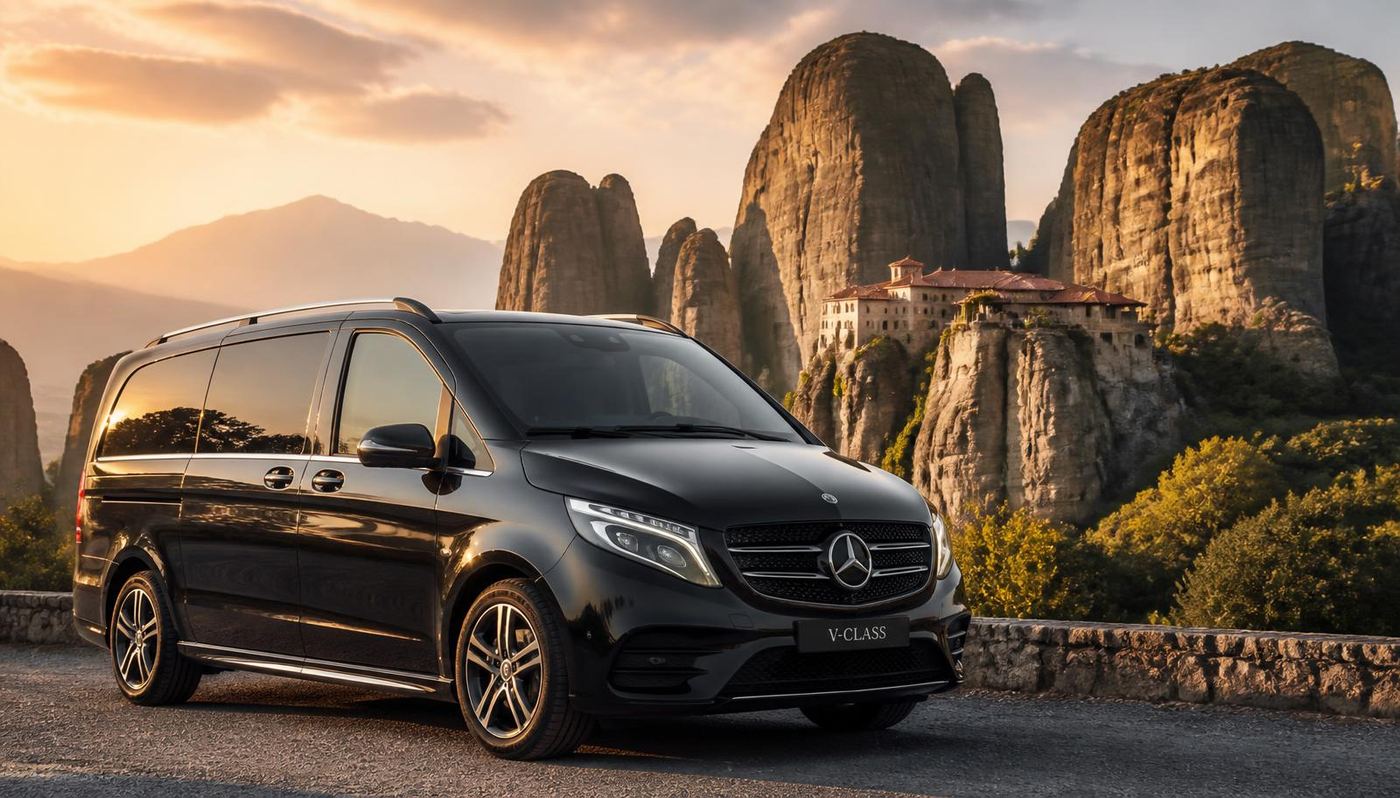
Six hours of driving is the part of this day nobody advertises, and it is the part a good vehicle changes completely. We run Mercedes-Benz only: E-Class sedans for up to three passengers, V-Class and Vito minivans for up to seven, and minibuses for larger parties. Every car is air-conditioned, non-smoking, cleaned between trips, and carries water, phone chargers and free child seats.
See the whole fleet and pricing, or read about our airport and hotel transfers if you also need arrival and departure rides.
Meteora: 53 questions, answered properly
These are the questions guests actually ask us, in the words they use. If yours is not here, message us — we answer within minutes, and we will tell you honestly if a private trip is not the right choice for you.
How far is Meteora from Thessaloniki?+
About 240 km, roughly 3 hours each way by motorway via the Egnatia Odos, the A1/PATHE and the E65 towards Kalambaka.
How long does a Meteora day trip from Thessaloniki take?+
Around 11–12 hours door to door: 3 hours driving each way, plus 4–5 hours for monasteries, viewpoints and lunch.
How much does a private Meteora tour cost?+
600€ total per vehicle, not per person: a private Meteora day trip in a Mercedes V-Class or Vito, for up to 7 passengers. You pay a 150€ deposit online and the 450€ balance to the driver by card or cash. Minibuses for larger groups are quoted individually. Tolls, fuel and the driver's full day are included.
Is the price per person or per vehicle?+
Per vehicle. Two people and six people pay the same for the same car, which is why private transport becomes cheaper than coach seats from about four passengers up.
What is included in the price?+
The vehicle, a professional English-speaking driver for the whole day, fuel, tolls, parking, bottled water, child seats and door-to-door pickup and drop-off. Monastery entrance fees, lunch and an optional licensed guide are not included.
Is a licensed guide included?+
No. We provide a private driver, not a licensed guide, which is what Greek law distinguishes between. Your driver knows the site extremely well and will explain the practicalities, and we can arrange a licensed local guide in Kalambaka for an additional fee if you want in-depth commentary inside the monasteries.
How many monasteries can we realistically visit in one day?+
Two or three. Each involves a climb, a walk and 30–45 minutes inside. Four is possible in June with an early start, but it turns the day into a march.
Which monasteries are the best to choose?+
For a first visit: Great Meteoron for scale and its museum, Varlaam for frescoes, and Roussanou or St. Stephen for the view. If steps are an issue, St. Stephen and the roadside viewpoints deliver most of the experience.
Which monastery has the fewest steps?+
St. Stephen — a short level bridge and no staircase. Roussanou is the next easiest at about 140 steps.
Which monastery has the most steps?+
Great Meteoron, at roughly 300 steps, with the ascent broken into sections.
Are all six monasteries open every day?+
No. Each closes one or two fixed days a week and the days are staggered, so there are always several open. Schedules change seasonally, so verify the current week before travelling — we check it for every booking.
What are the entrance fees?+
A small fee per adult per monastery, 5€ at the time of writing, paid in cash at the gate. Children are usually free. Fees are set by the monasteries and can change.
Can I pay the entrance fee by card?+
Generally no. Bring cash in small notes — one visit for two people across three monasteries needs around 30€.
What is the dress code?+
Long trousers for men, a skirt below the knee for women, covered shoulders for everyone. Wraps and shawls are lent free at the entrances, though they are shared and hot in summer.
Can women wear trousers into the monasteries?+
Most monasteries ask women to wear a skirt and provide a wrap-around skirt at the gate to put over trousers. Enforcement varies slightly between monasteries; assume the stricter rule and you will never be turned away.
Can I wear shorts?+
No. Shorts are refused for men and women at the gate, even at knee length.
What shoes should I wear?+
Trainers or walking sandals with grip. The steps are worn stone and can be slippery, especially after rain.
Is photography allowed?+
Outside and in most courtyards, yes. Inside the churches, no — the frescoes are fragile and the rule is enforced. Always look for the sign or ask.
Can I fly a drone at Meteora?+
Drone flight is restricted around the monasteries and the protected area. Do not assume it is allowed; check the current national and local rules, as fines are significant.
What is the best time of year to visit Meteora?+
May, early June, September and October offer the best combination of weather, light and manageable crowds. April is beautiful and green; winter is quiet and dramatic; July and August are hot but workable with an early start.
What is the best time of day?+
Arrive by 10:00. Coach groups from Athens and Thessaloniki land between 11:00 and 15:00, and the difference in atmosphere is remarkable.
Is Meteora worth visiting in winter?+
Yes, and it is our own favourite season. Empty monasteries, soft light and snow-dusted rock. Days are shorter and some monasteries close earlier, so plan two monasteries rather than three.
Does it snow in Meteora?+
Occasionally between December and February. The roads are cleared quickly, but the monastery road can be temporarily closed during heavy snowfall — we monitor it and will reschedule rather than risk it.
What happens if it rains?+
The trip runs. Rain actually makes the rock dramatic, and the monastery interiors are indoors. We simply reorder the stops and skip exposed viewpoints. If conditions become genuinely unsafe, we reschedule or refund.
How hot does it get in summer?+
35–38°C in the Thessaly plain in July and August. It is noticeably cooler on the rocks and inside the monasteries. Start early, drink constantly, and use the middle of the day for a long lunch.
Can we visit Meteora from Halkidiki?+
Yes. We collect from Sani, Ikos, Porto Carras, Miraggio, Kassandra, Sithonia and any villa. The drive is longer than from Thessaloniki, so we depart earlier and the price reflects the distance.
Can you pick us up from Thessaloniki Airport (SKG)?+
Yes, including directly on arrival if you want to see Meteora on your first day. Luggage is not a problem in the V-Class.
Can you pick us up from a cruise ship?+
Yes. We plan the whole day backwards from your all-aboard time and stay reachable on WhatsApp throughout.
How early do we leave?+
Typically 06:45–07:00 from Thessaloniki, or around 06:00 from Halkidiki. Later departures are possible but you trade quiet monasteries for a lie-in.
Can we stay for sunset?+
Yes. In spring and autumn the timing works comfortably. In midsummer the sun sets after 20:30, which makes for a very long day — some guests do it anyway, and it is spectacular.
Is lunch included?+
No, but it is planned. Your driver will recommend and book a taverna in Kalambaka or Kastraki, including places with terraces facing the rocks.
Are there vegetarian and vegan options?+
Plenty. Greek monastic fasting tradition means Thessalian cooking is full of excellent vegetable dishes. Tell us about allergies and we choose the restaurant accordingly.
Can we stop on the way?+
As often as you like. It is your vehicle for the day — coffee, photos, a village, Mount Olympus on the return. There is no group waiting for you.
What vehicles do you use?+
Mercedes-Benz: E-Class sedans for up to 3 passengers, V-Class and Vito minivans for up to 7, and minibuses for larger groups. All air-conditioned, non-smoking, with water and phone charging.
Are child seats available?+
Yes, free of charge — infant, toddler and booster. Tell us the ages when you book.
Can we bring luggage?+
Yes. Many guests do the trip on their arrival or departure day and travel with everything. Say so when booking and we allocate a larger vehicle.
Are pets allowed?+
Small pets in a carrier are usually fine — please ask before booking. Note that animals are not admitted inside the monasteries.
Is Meteora suitable for elderly travellers?+
Yes, with a plan built around St. Stephen and the drive-up viewpoints. We will be honest with you about which monasteries to skip.
Is Meteora wheelchair accessible?+
Partially. St. Stephen is step-free, and several major viewpoints are within metres of a vehicle. The other five monasteries are not accessible, and no honest operator will tell you otherwise.
How many people fit in one vehicle?+
Up to 3 in a sedan, up to 7 in a V-Class or Vito, and 8–19 in a minibus. Larger parties are split across vehicles travelling together.
Do you offer Meteora tours in languages other than English?+
Our drivers speak English and Greek; German is available on request. For French, Italian or Spanish commentary we arrange a licensed guide in Kalambaka.
How do I book, and what deposit is required?+
Book online with a 150€ deposit that secures the date, with the balance paid to your driver on the day by card or cash. You can also confirm everything by WhatsApp first.
Can I cancel or change the date?+
Yes. Free cancellation and date changes up to 48 hours before pickup; within 48 hours the deposit is retained. Weather-related rescheduling is always free.
Is there a hidden cost or fuel surcharge?+
No. The quoted price includes fuel, tolls, parking and the driver's entire day. The only things you pay separately are entrance fees, food and any optional guide.
Can we combine Meteora with another destination?+
Yes — Mount Olympus and Litochoro on the return, Trikala old town, or Theopetra Cave near Kalambaka. Ask and we will build the route.
Should we stay overnight in Kalambaka instead?+
If you love photography or want both sunrise and sunset, an overnight is genuinely better. We can do a one-way transfer there and collect you the next day.
Where should we stay if we do stay overnight?+
Kalambaka has the widest hotel choice and rock-view terraces; Kastraki is quieter, more village-like and closer to the trailheads. Both are five minutes apart.
How long should we spend at each monastery?+
Thirty to forty-five minutes inside, plus ten to fifteen minutes on the climb. Great Meteoron with its museum takes closer to an hour.
Are there toilets and cafés at the site?+
Toilets exist at most monasteries and in the car parks. Cafés and shops are concentrated in Kastraki and Kalambaka rather than on the monastery road, so carry water.
Is there mobile signal and Wi-Fi?+
Mobile coverage is good throughout the area, including on the monastery road. Wi-Fi is available in restaurants and hotels in town.
Can we visit Meteora on a Sunday or a public holiday?+
Yes, though monasteries can open later on Sundays and major feast days because of services, and the site is busier with Greek visitors. We adjust the departure time accordingly.
Is Meteora religious tourism or sightseeing?+
Both, and it deserves to be treated as the former. People live and pray here. Modest behaviour and quiet voices inside are all that is asked, and they are asked genuinely.
How reliable are the monastery opening days published online?+
Broadly reliable but not guaranteed — they change with the season, feast days and restoration work. Always verify shortly before you travel; we do this for every booking the day before.
Book your private Meteora day
Door-to-door Mercedes with an English-speaking driver for the whole day. Fuel, tolls, parking, water and child seats included. 150€ deposit secures the date; the balance is paid to your driver by card or cash.
Free cancellation up to 48 hours before pickup · free rescheduling for bad weather
The Meteora library
Every topic below is already covered on this page — tap any card to jump straight to it. Longer standalone guides live on our travel blog.
- The Complete Meteora Travel GuideInformational · meteora travel guide
- The Six Monasteries of Meteora: Which to Visit and WhyInformational · best monasteries in meteora
- Meteora Dress Code: What to Wear (and What Gets You Refused)Informational · meteora dress code
- Best Time to Visit Meteora, Month by MonthInformational · best time to visit meteora
- Meteora with Kids: A Parent's Field GuideInformational · meteora with children
- Meteora in Winter: Snow, Silence and Empty MonasteriesInformational · meteora in winter
- Meteora Photography Guide: Lenses, Spots and LightInformational · meteora photography
- The Best Sunset Spots in MeteoraInformational · meteora sunset
- Where to Eat in Kalambaka and KastrakiInformational · meteora restaurants
- Driving from Thessaloniki to Meteora: Route, Tolls, TimingInformational · drive thessaloniki to meteora
- Parking at Meteora: Where to Leave the CarInformational · meteora parking
- Where to Stay Near Meteora: Kalambaka vs KastrakiCommercial · where to stay meteora
- One Day in Meteora: The Perfect ItineraryInformational · meteora one day itinerary
- Two Days in Meteora: Sunrise, Sunset and the TrailsInformational · 2 days in meteora
- The History of Meteora: Hermits, Ropes and EmpiresInformational · meteora history
- Why Meteora Is a UNESCO World Heritage SiteInformational · meteora unesco
- Hidden Gems Near Meteora Most Visitors MissInformational · things to do near meteora
- What to Pack for a Meteora Day TripInformational · what to pack meteora
- How Much Does a Trip to Meteora Cost?Commercial · meteora tour cost
- Is Meteora Worth Visiting? An Honest AnswerInformational · is meteora worth it
- Meteora from Thessaloniki: Every Way to Get ThereCommercial · thessaloniki to meteora
- Meteora from Halkidiki: Sani, Ikos and KassandraCommercial · meteora from halkidiki
- Meteora by Train from Thessaloniki: Does It Work?Informational · train to meteora
- Meteora for Cruise Passengers Docking in ThessalonikiCommercial · meteora shore excursion
- Meteora Hiking Trails: The Monk PathsInformational · meteora hiking
- Accessible Meteora: Visiting with Limited MobilityInformational · meteora wheelchair accessible
- Meteora Weather Guide and What It Means for Your DayInformational · meteora weather
- Theopetra Cave: 130,000 Years Next Door to MeteoraInformational · theopetra cave
- Meteora vs Mount Athos: Which Should You Visit?Informational · meteora vs mount athos
- Private Tour vs Group Tour to Meteora: The Real DifferenceCommercial · private meteora tour
- Meteora Opening Hours and Entrance Fees ExplainedInformational · meteora opening hours
- A Photographer's 48 Hours in MeteoraInformational · meteora photo tour
Continue planning
Meteora is inscribed on the UNESCO World Heritage List under both cultural and natural criteria.